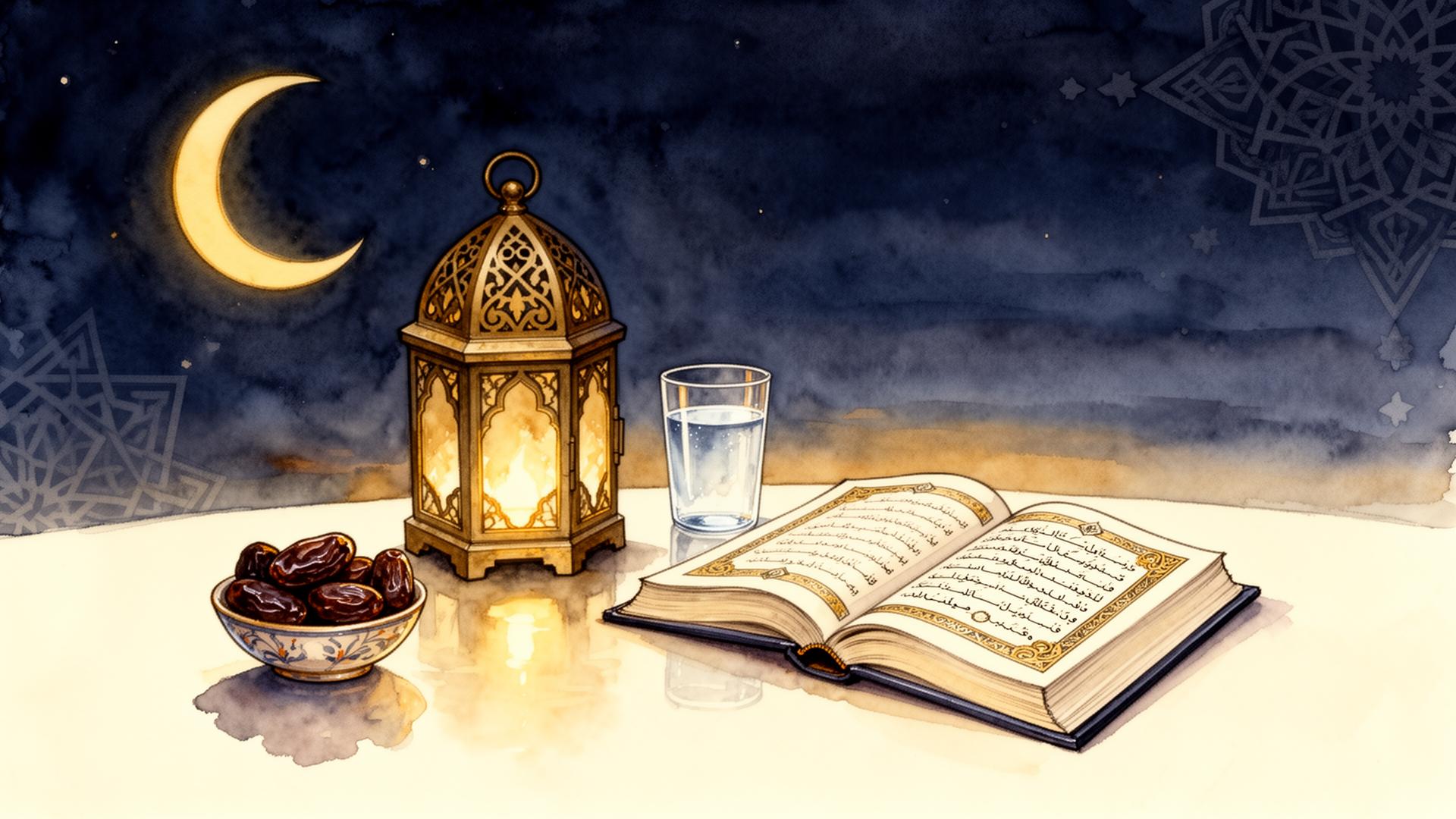
What is Ramadan?
Ramadan is the ninth month of the Islamic lunar calendar and, for Muslims, a special time of fasting, spirituality, self-discipline, gratitude, prayer, Qur'an recitation, charity and community.
Because Ramadan follows the lunar calendar, its dates shift every year. The exact start can vary slightly depending on moon sighting, country and religious authority.
What does fasting mean?
During Ramadan, fasting means consciously abstaining from food, drink and other things that break the fast, from dawn until sunset. At the same time, it is not only about outward abstinence but also about inner orientation: patience, mindfulness, gratitude, self-control and closeness to God.
Suhur and Iftar
Suhur is the meal before the fast begins at dawn. Iftar is the breaking of the fast after sunset. Many people traditionally break the fast with dates and water and then share a meal with family, friends, community or guests.
Dua for breaking the fast
Many Muslims recite a dua when breaking the fast. Depending on family, region and religious practice, different transmitted wordings may be known.
اللَّهُمَّ لَكَ صُمْتُ وَعَلَى رِزْقِكَ أَفْطَرْتُ
Allahumma laka sumtu wa ʿala rizqika aftartu.
TransliterationMeaning:O Allah, for You I have fasted and with Your provision I break my fast.
ذَهَبَ الظَّمَأُ وَابْتَلَّتِ الْعُرُوقُ وَثَبَتَ الْأَجْرُ إِنْ شَاءَ اللَّهُ
Dhahaba aẓ-ẓamaʾu wabtallatil-ʿurūq wa thabatal-ajru in shāʾa Allāh.
TransliterationMeaning:The thirst is gone, the veins are moistened and the reward is certain, if Allah wills.
These duas are intended as general orientation. Depending on the school of law, the assessment of the narration and local practice, different wordings may be used. For religious questions, please consult a trustworthy religious source or local community.
Intention (Niyyah)
In Islam, intention plays a central role. Fasting is not only about the outward act but also about consciously fasting for God. Many people make the intention inwardly before each fasting day. The exact wording can vary depending on practice.
This page offers only a general introduction and does not replace religious advice.
Ramadan as the month of the Qur'an
Ramadan is closely connected with the Qur'an. Many Muslims deliberately take more time during this month for Qur'an recitation, reflection, learning and spiritual contemplation.
Read a short passage each day, look up a meaning or reflect together with others.
Prayer, Tarawih and community
Alongside fasting, prayer plays an important role during Ramadan. Many communities gather in the evenings for additional prayers. For many people, Ramadan is therefore also a month of encounter, of the mosque, of family and of shared learning.
Prayer times and local offerings differ from community to community.
Sadaqah, Zakat and sharing
Ramadan is also a time of generosity. Many Muslims give more deliberately during this month, support those in need, invite people to Iftar or get involved in the community.
The last ten nights and Laylat al-Qadr
The last ten nights of Ramadan hold a special meaning for many Muslims. During this time, particular attention is given to prayer, dua, Qur'an, sadaqah and personal reflection. Laylat al-Qadr, the Night of Decree, is often sought on the odd-numbered nights within the last ten.
The exact date is treated differently across traditions. Many people therefore make a special effort across all of the last ten nights.
Eid al-Fitr
Eid al-Fitr, often called the festival of breaking the fast, marks the end of Ramadan. It is a day of prayer, joy, family, visits, sharing and gratitude. Before the Eid prayer, Zakat al-Fitr is given so that those in need can also take part in the celebration.
Ramadan for guests and colleagues
Anyone invited to an Iftar does not need to fast themselves. What matters is respect, punctuality, openness and an understanding that prayer times, religious practice and shared eating can be part of the evening.
- Arrive on time for the breaking of the fast
- When unsure, simply ask respectfully
- Don't force long debates about fasting during the meal
- A small gift such as dates, sweets or a card is often a kind gesture
- Respect prayer times
Frequently asked questions
Do I have to fast if I'm invited to an Iftar?
No. Guests do not have to fast. Many Iftars are intentionally open to friends, colleagues or neighbours.
Why are dates and water often served?
Many people traditionally break the fast with dates and water. Prayer often follows, and then a larger meal.
Can I take part as a non-Muslim?
If you have been invited or the event is public, yes. What matters is respect, openness and following any guidance given by the hosts.
When does Ramadan start?
Ramadan follows the Islamic lunar calendar. The exact start can vary depending on moon sighting and local announcement.
Where can I find Iftar offerings?
In the Iftar.at calendar and under Restaurants & Menus you can find events, venues and possible Iftar offerings in Austria.
Sources & notes
- Islamic Relief: Ramadan, Iftar and Suhur
- Islamic Relief: Duas in Ramadan
- Islamic Relief: Laylat al-Qadr
- Guidance from local Islamic communities
This page offers a general introduction to Ramadan, fasting and spiritual practices. It does not replace religious advice, a fatwa or medical advice. For personal religious questions, please turn to a trustworthy religious contact or your local community.